The Tenth Swan
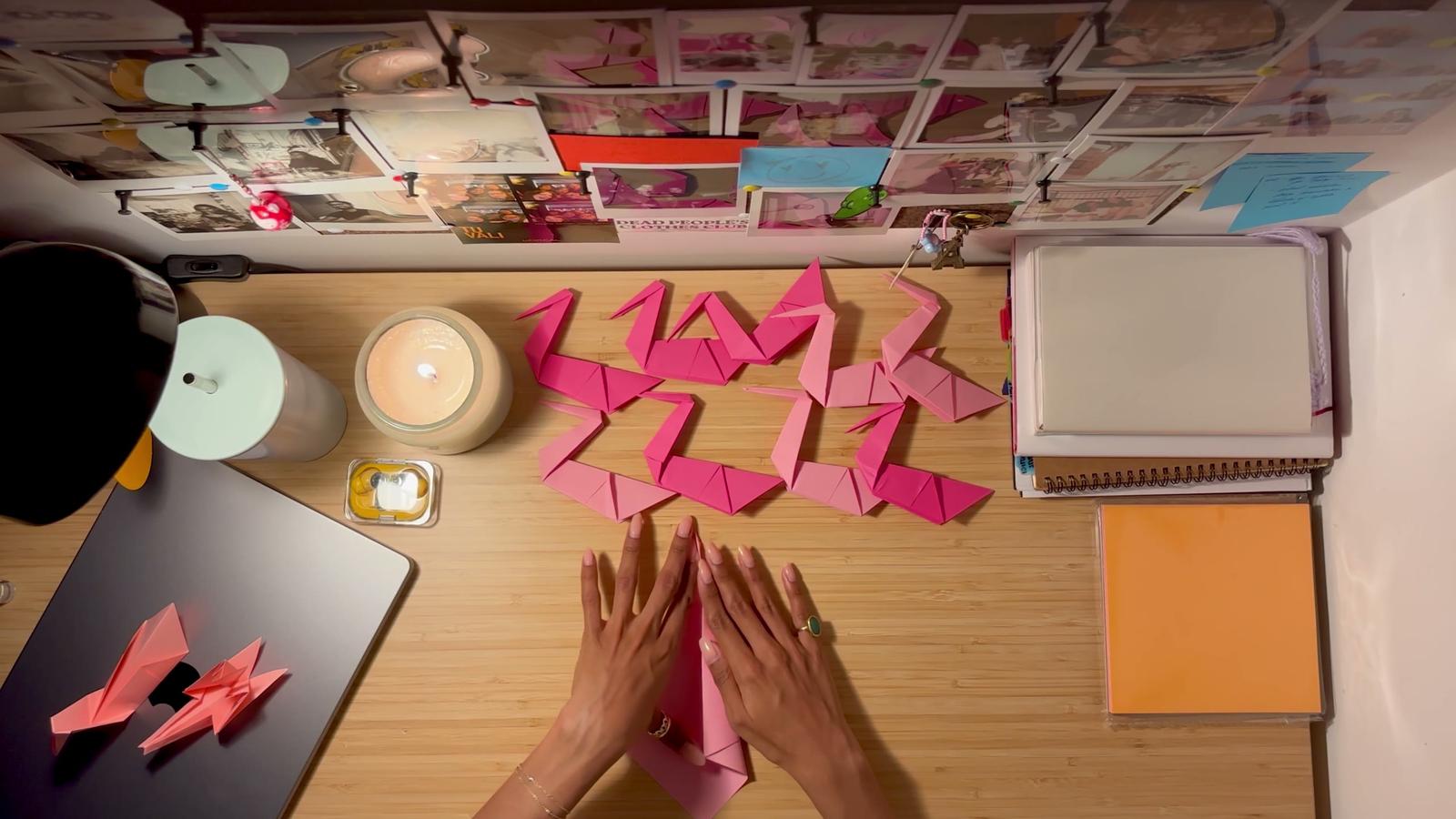
The Tenth Swan is a durational, single-shot video performance that documents the final gesture in a sequence of manual labour: the folding of one last origami swan. In the frame, two uneven rows of already-folded swans stretch across the table—some crisp and symmetrical, others slack or askew. They are not staged as perfect outcomes but exist as visible residues of prior effort. The viewer watches only the final act unfold in real time, marked by haphazard motion, irregular creases, and the quiet urgency of a tired body trying to complete a task it has already repeated too many times.
There are no tools, no edits, no precision instruments—just bare hands and paper. The folding is unhurried but no longer careful. At times, the hands pause to nudge earlier swans back into position, subtly rearranging the scattered traces of the labour already spent. Unlike traditional origami demonstrations, this piece is not about skill display. It is about what happens when repetition overtakes refinement, when control begins to slip.
The title alludes to both repetition and failure. The swan, typically a symbol of grace, is rendered flawed in this final act. This is not a performance of mastery, but of slow degradation—an honest, human endpoint to a private choreography of care and control.
Influenced by Harun Farocki and Antje Ehmann’s Labour in a Single Shot, the video avoids spectacle. It distills labour to its simplest gestures: folding, adjusting, placing. By showing only the last act and leaving the earlier nine as visible evidence, the work reverses the typical process-performance relationship. The audience doesn’t witness the full repetition, but they encounter its consequences.
This isn’t failure—it is presence.
The film explores the anthropic condition: how labour, exhaustion, and imprecision mark the human presence in even the smallest actions. Where machines might replicate perfectly, the human hand erodes under time and repetition. The final swan is not precise, but personal. It becomes the material trace of effort meeting limitation.
The pacing of the work reflects this tension. The final folds happen faster, less delicately, as physical and mental fatigue become visible. The two rows of swans do not form an orderly grid; they shift slightly, unevenly—just like the gesture that created them. This isn’t failure—it is presence.
The Tenth Swan resists perfection. It replaces polish with exhaustion, control with gesture, and symmetry with entropy. It is a small act, performed at the edge of care, shaped by repetition and softened by fatigue. It is not the start of a process, but the visible end of one.